Empirical model to predict bedload flux
On the previous note, I shared a summary on the physics-based models of seismic noise generated by sediment transport as using seismic methods to track bedload transport is an active field of research recently. There are several limitation of applying either the saltation model (Tsai et al., 2012) or multi-mode model (Luong et al., 2024) model to estimate bedload flux, mainly due to a very high dimensional space of model parameters. Namely, there are more than 22 model parameters, some of that we need to have a very good constrains in order to obtain a reasonable inversion.
The physics-based model of seismic noise generated by bedload transport is quite complex, and applying this model to invert back to bedload flux is still challenging, largely uncertainty of several model parameters (e.g., seismic velocity, Green’s function related parameters, or bedload particle hop times).
The physics-based model is expressed as:
$$ P_T(f, x) = \int_D \int_t p_t(t_D) \cdot \frac{p(D) q_b W}{V_p U_b t_D} \cdot \left| N_{11} (1 + \gamma) U_b f_z \right|^2 \cdot \frac{\pi^2 f^3 m^2}{4 \rho_s^2 v_c^3 v_u^2} \cdot \chi(\beta) \, dt_D \, dD $$
In this note, I wanted to summary what we changed to derive an empirical equation that takes seismic predictor into account as well as the traditional hydraulic predictor. The idea is to reduce the complicated relationship between PSD (which is $P_T$ in the above equation) and $q_b$ into a simpler equation. Our main hypothesis is that hydraulic equation (based on fluid flow) can predict the mean trend of bedload flux pretty decent, and variability of bedload flux with respect to the mean trend should be reflected in the seismic signals stemming from the riverbed.
Our proposal for the combination of seismic and hydraulic information into a very simple equation:
$$ q_b = a \left(\frac{P}{P_{re}}\right)^b \left(\tau_{\ast} - \tau_{cr\ast}\right)^c $$
where $q_b$ is non-dimensional bedload flux, $P$ is observed seismic power spectral density (PSD), $P_{re}$ is a reference seismic PSD at a given shear stress, $\tau_{\ast}$ is Shield parameter, and $\tau_{cr\ast}$ is critical Shield required to initiate the movement of sediment particles; $a$, $b$, $c$ are model parameters obtained from fitting equation with observational data.
In this equation, $\tau_{\ast} - \tau_{cr\ast}$ comes out of the traditional ideas (e.g., MPM equation) which represents the amount of energy that stream exerts on the riverbed to initiate and carry sediment particle along the flow. Even though with the same flow depth (or same stream power), the amount of bedload flux can fluctuate significantly (e.g., low or high compared to the mean value), depending on bed conditions, turbulence, or other factors (e.g., grain size and sorting). Our contribution is to show that $\frac{P}{P_{re}}$ can be added to represents the variability of bedload flux.
Even though there is a strong correlation between seismic PSD and shear stress $\tau$, we still hypothesize that adding seismic PSD as a new predictor improves hydraulics-based equation in terms of predicting bedload flux. We divided our dateset and set up different metrics to challenge the hypothesis as much as possible. The null hypothesis $H_0$ is that adding the new seismic PSD does not improve the hydraulic model as implied by: (1) a fit of $m = 0$ in the above equation; (2) minimal contribution of the added PSD in explaining the variance of bedload flux beyond what is already explained by the existing hydraulic-based model.
It turns out that the fitting gets us a pretty neat equation as follows:
$$ q_b = 5.2 \left(\frac{P}{P_{re}}\right)^{0.25} \left(\tau_{\ast} - \tau_{cr\ast}\right)^{1.36} $$
And this equations passed several statistical tests to reject the null hypothesis. We also validate this with independent flow events as well as other data sets from different stream. This mean adding new seismic information does improve the prediction capability of hydraulic-based models. Finally, we named this as “seismic-hydraulic” equation.
Detail on the derivations as well as results can be accessed here!
Flash floods at the Arroyo de Los Pinos
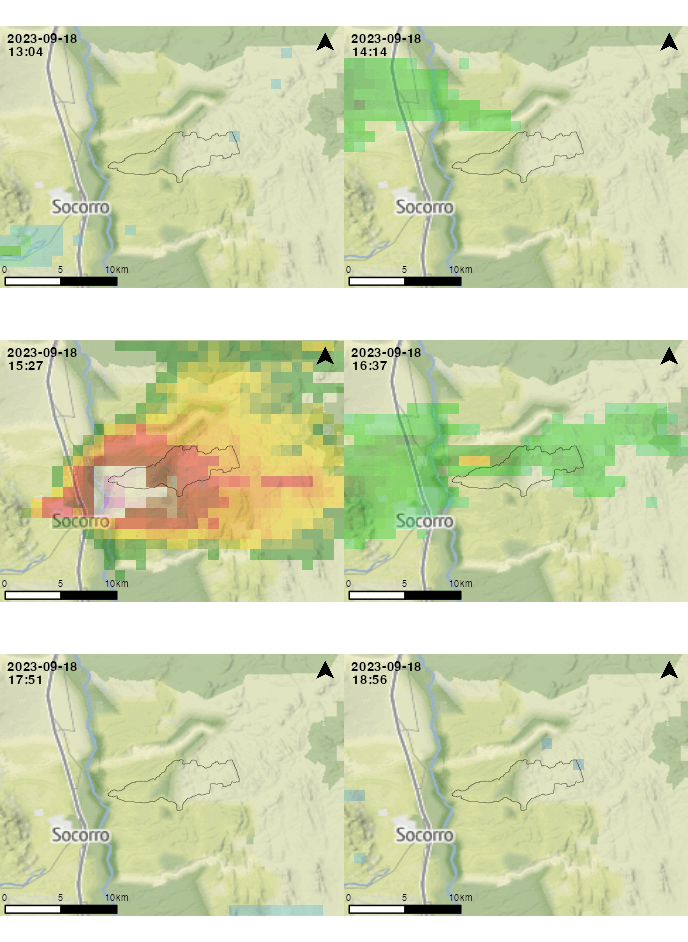
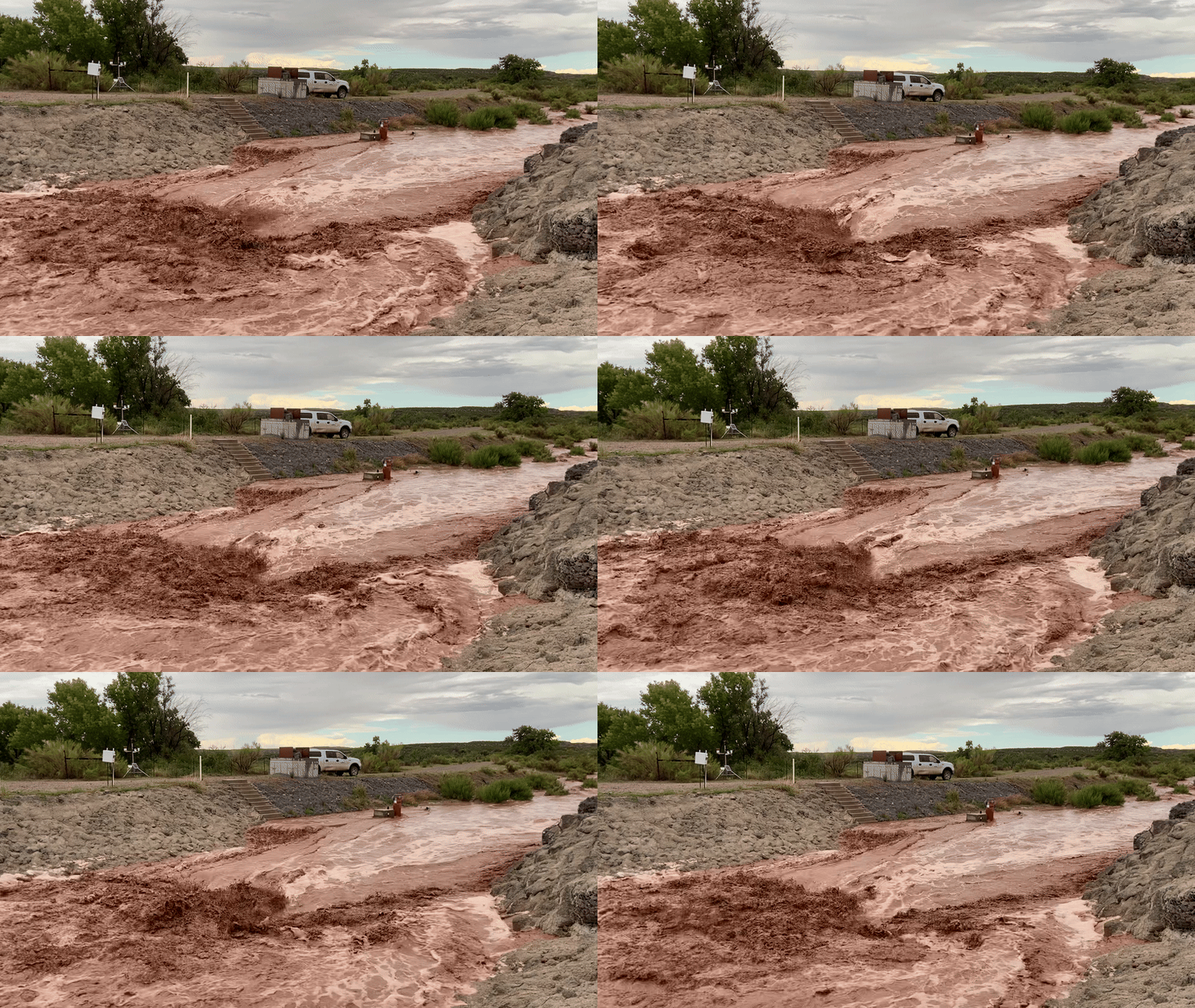
During the monsoon seasons, we chased flow events at a small channel, essentially we chased the rain and observed flash floods at a natural lab set up at the arroyo de los Pinos–a tributary of the Rio Grande. Our work during summer is to track the radar and looking the weather forecast; and every times we see signs indicating that it is likely to rain at our basin, we rush ourself into a truck full of tools/equipments for measuring river flow and sediment transport. The fun thing about this is sometimes we were lucky to witness the raw, powerful nature of flowing water, sometimes we were unlucky and false alarm happened at about $50\%$ of the time!
We also set up a bunch of instrumentation network from upstream to downstream, including rain gauges, level loggers, seismometers, and at the monitoring point there are 3 sediment boxes to trap bedload during floods. These instruments help us to collect a wealth of information about rainfall/runoff, water flow, ground vibration (seismic sensors), and bedload flux. Here is an example of a flood event at the watershed.
References
[1] Tsai, V.C., Minchew, B., Lamb, M.P. and Ampuero, J.P., 2012. A physical model for seismic noise generation from sediment transport in rivers. Geophysical research letters, 39(2).
[2] Luong, L., Cadol, D., Bilek, S., McLaughlin, J.M., Laronne, J.B. and Turowski, J.M., 2024. Seismic modeling of bedload transport in a gravel‐bed alluvial channel. Journal of Geophysical Research: Earth Surface, 129(9), p.e2024JF007761.
[3] Luong, L., Cadol, D., Turowski, J.M., Bilek, S., McLaughlin, J.M., Stark, K. and Laronne, J.B., 2026. An empirical model combining seismic noise and shear stress to predict bedload flux in a gravel‐bed alluvial channel. Water Resources Research, 62(2), p.e2025WR040371.