Groundwater modeling and solute transport in an unconfined aquifer
Beside my main PhD focus on environmental seismology and sediment transport, I also had a chance to contribute to the implementation the finite volume method (FVM). In this note, I wanted to summary the underlying concepts of the method, along with its algorithmic structure and implementation, and present results from simulations in which the computational grid evolves dynamically over time.
The hypothesis that leads to this implementation is that onshore saline groundwater within unconfined aquifer in delta system may have resulted from rapid propagation of shoreline during Holocence which was around 12k years ago.
To test this hypothesis, we develop a control volume finite element method (CVFEM) to simulate groundwater flow, solute transport, and groundwater age in an aquifer subject to a prograding delta, represented as an evolving computational domain. In this framework, all governing equations are solved using triangular elements on a dynamically evolving mesh.
We also ran a series of sensitivity analyses using a range of model configurations to indentify the key parameters that control the groundwater age and salinity distribution. Our results show that groundwater age is strongly influenced by the presence of two confining units in the Bengal Delta. There are two mechanisms to explain this entrapment of seawater. The first mechanism is that rapid progradation and evolution of the delta system physically trapped seawater inland as the shoreline moved seaward. This rapid progradation can push the delta outward quickly. And when sea level rises, new layers of sediment can trap and create seawater pockets inland by deposition of low permeable sediment layers (e.g., silt, clay). Through many cycles of sea level rises and falls, it can generate and isolate more and more seawater pockets. The second mechanism is that, during earlier stages of delta evolution, when the confining unit was submerged beneath seawater, saline water infiltrated and became trapped within the formation. As the shoreline prograded, this saline groundwater was preserved inland. Over time, the confining unit can release saline water through diffusion, which is then advected by groundwater flow.
Summary
The fundamental equation that governs the groundwater flow in an aquifer for incompressible fluid is described as follows:
$$ \frac{\partial}{\partial x} \left( K_{xx} \frac{\partial h}{\partial x} \right) + \frac{\partial}{\partial z} \left( K_{zz} \frac{\partial h}{\partial z} \right) + C (\rho_{\text{rel}} - 1) = S_s \frac{\partial h}{\partial t} $$
where $K_{xx}$ and $K_{zz}$ are hydraulic conductivity $(LT^{-1})$ in $x$ and $z$ dimensions, $h$ is hydraulic head ($L$), $S_s$ is specific storage ($L^{-1}$), $C$ is concentration of saltwater. The hydraulic head is estimated as:
$$ h = \frac{p}{\rho_w g} + z $$
The governing equation is for age transport with uniform porosity is:
$$ \frac{\partial \tau}{\partial t} = \nabla \cdot \left(\mathbf{D} \cdot \nabla \tau\right) - \nabla \cdot (\mathbf{v} \tau) + 1 $$
In two dimensions, the equation becomes:
$$ \frac{\partial \tau}{\partial t} = \frac{\partial}{\partial x} \left[ D_{xx} \frac{\partial \tau}{\partial x} + D_{xz} \frac{\partial \tau}{\partial z} \right] + \frac{\partial}{\partial z} \left[ D_{zz} \frac{\partial \tau}{\partial z} + D_{zx} \frac{\partial \tau}{\partial x} \right] - \frac{\partial}{\partial x} \left[ K_{xx} \frac{\partial h}{\partial x} \right] - \frac{\partial}{\partial z} \left[ K_{zz} \frac{\partial h}{\partial z} + C (\rho_{\text{rel}} - 1) \right] + 1 $$
where the dispersion tensor $\mathbf{D}$ is defined as:
$$ D_{xx} = \alpha_L \frac{v_x^2}{|v|} + \alpha_T \frac{v_z^2}{|v|} + D $$
$$ D_{xx} = \alpha_L \frac{v_z^2}{|v|} + \alpha_T \frac{v_x^2}{|v|} + D $$
$$ D_{xx} = (\alpha_L - \alpha_T) \frac{v_x v_z}{|v|} $$
and $\alpha_L(L)$ is longitudinal dispersivity, $\alpha_T(L)$ is transverse dispersivity, $v_x$ is groundwater velocity in $x$ direction, $v_z$ is groundwater velocity in $z$ direction, $D$ ($L^{2}T^{-1}$) is molecular diffusion of saltwater, and $\tau(T)$ is groundwater age.
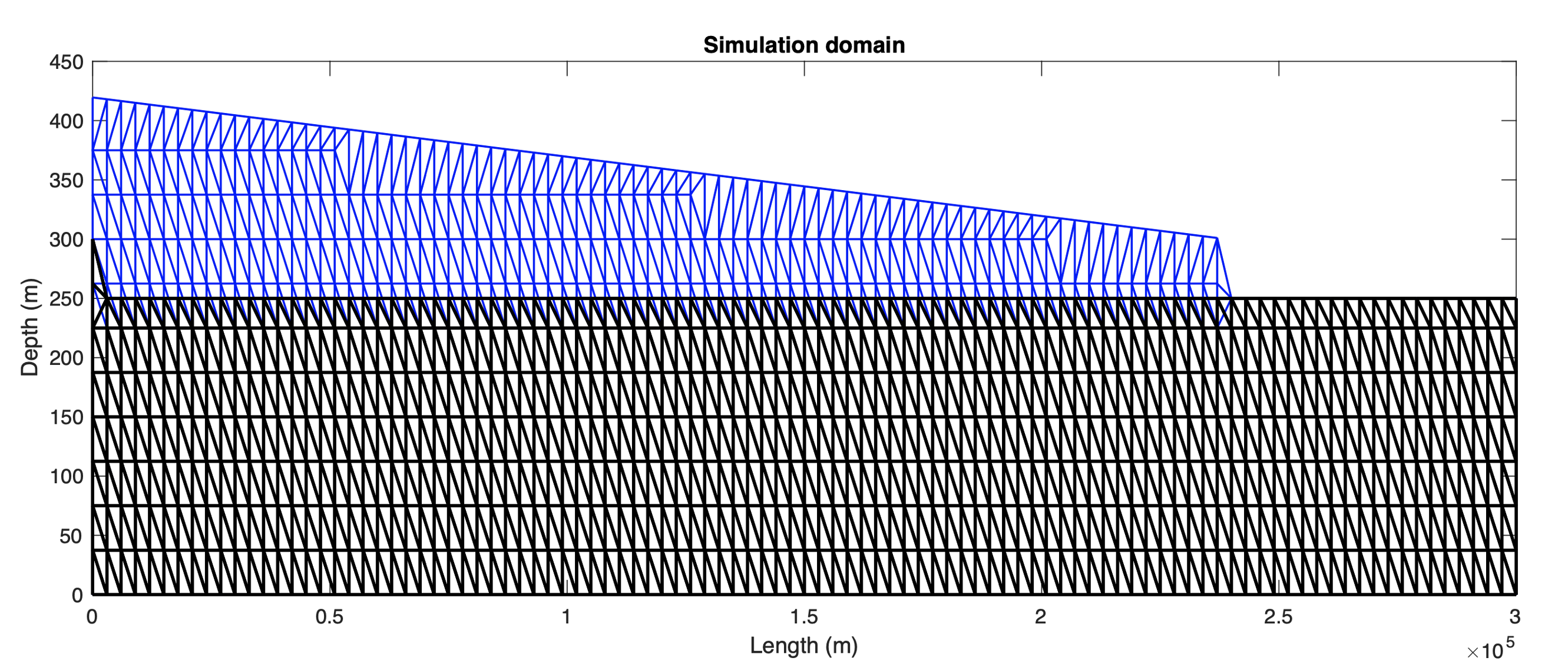
To simplify the domain as much as possible, we only depict the Bengal delta with a very coarse and simple conceptual 2D domain (figure above). The simulation domain of this model is in two dimensions (length and depth), and the top domain evolves over time. The model is represented by triangular mesh using a built-in function in MATLAB. We employed a straightforward mesh technique by joining x and z coordinates, then use a Delaunay triangulation from the points in a matrix P that contain x and z coordinates. The recharged area is located at the uppermost portion of the domain and discharged area is located at basement, which is at the same level as the sea level. We imposed no-flow boundaries for left, right, and bottom edges of the domain. Above sea level, we set salinity concentration to be zero.
Results
Here are final results from running simulation for ~ 16000 years.
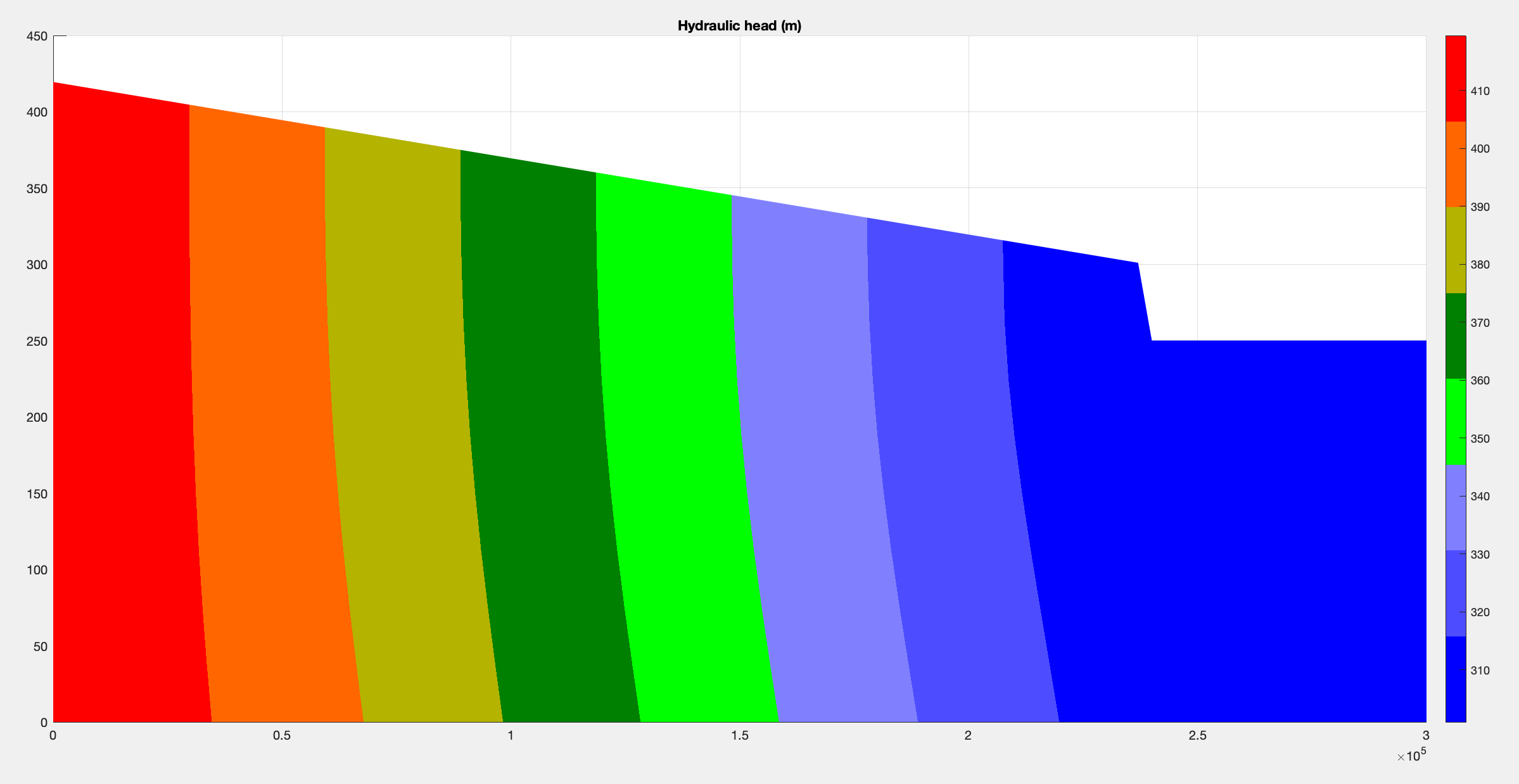
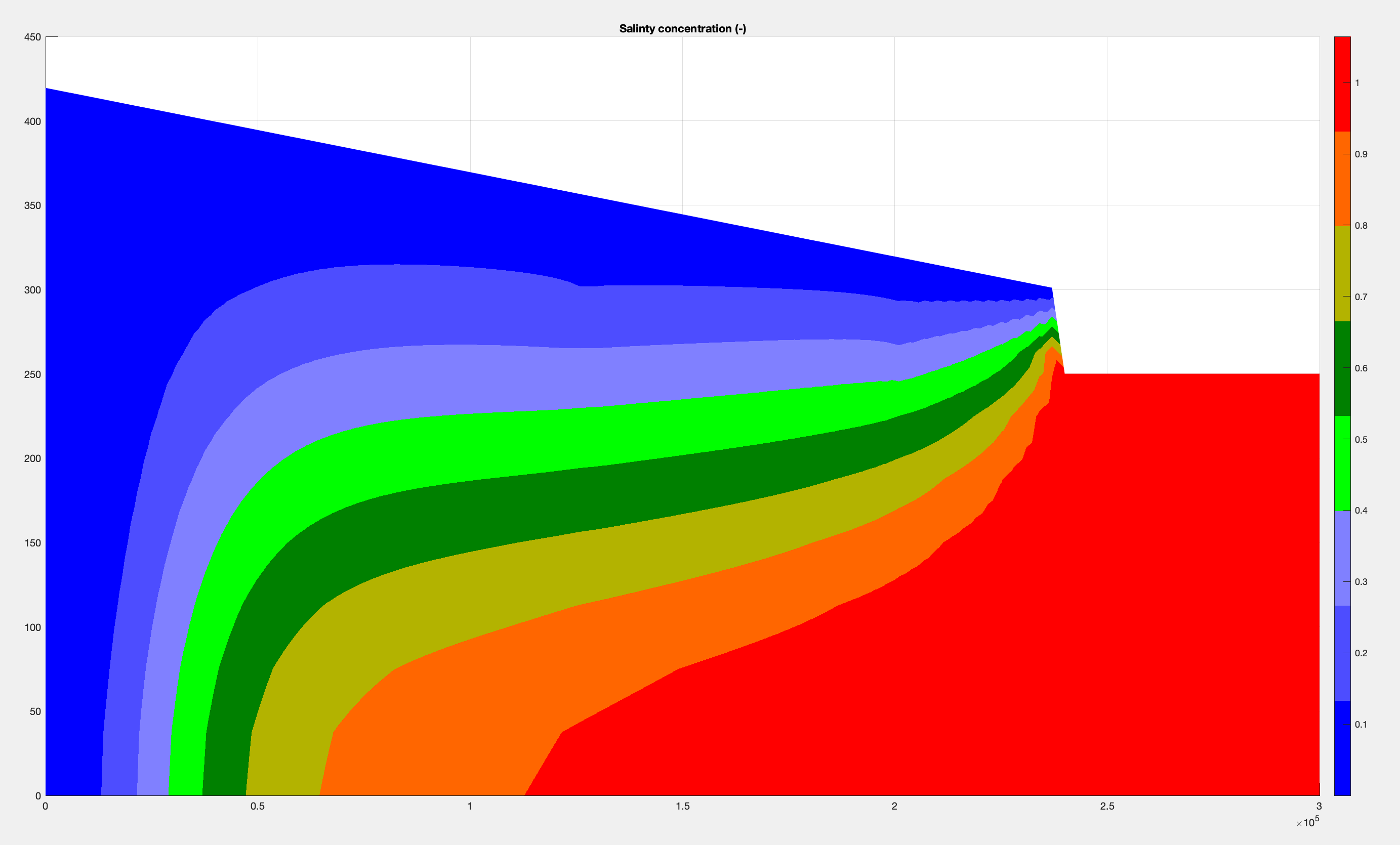
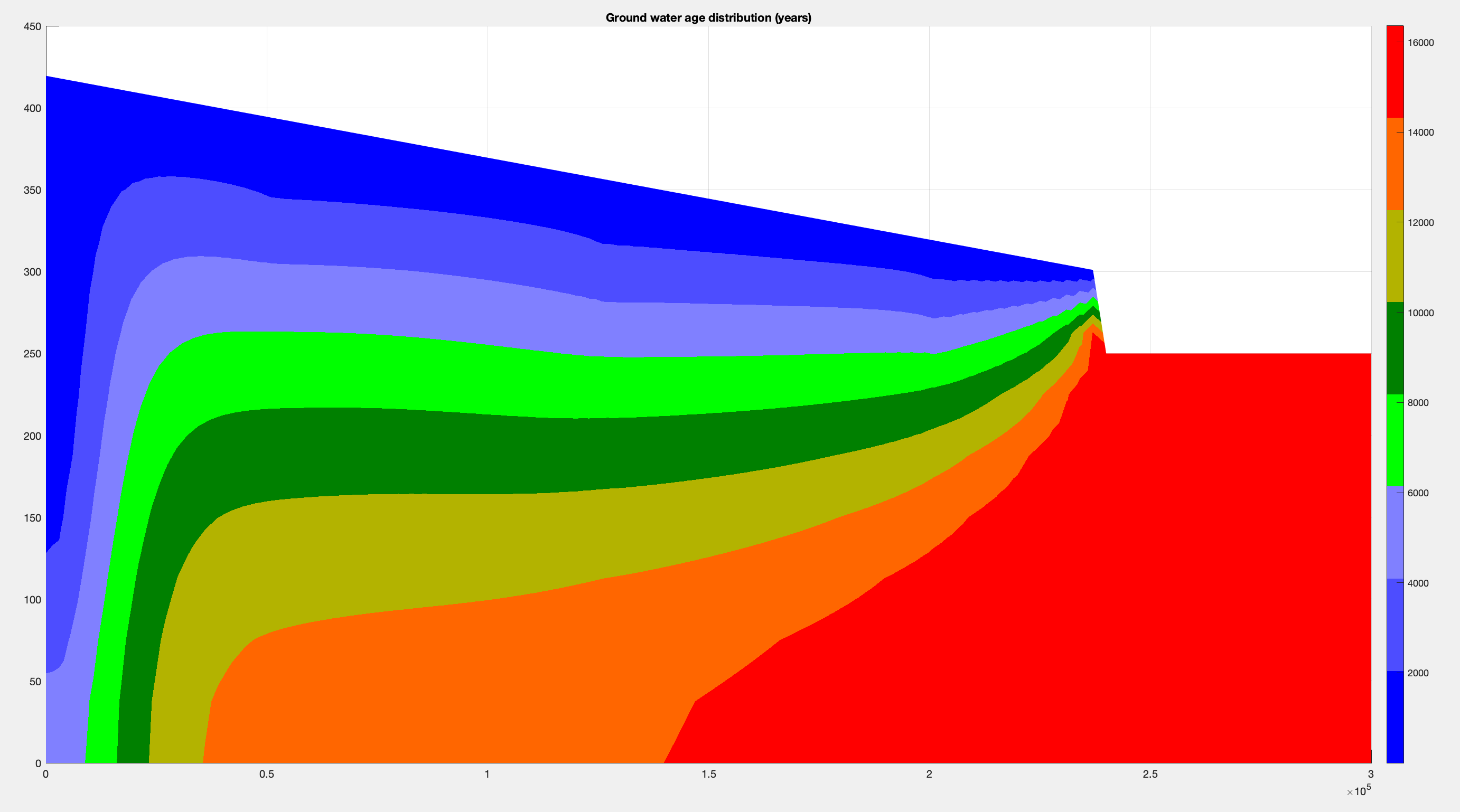
Age distributions are young in recharge areas , and old near the shore lines. Below is a gif showing concentration evolves over time:
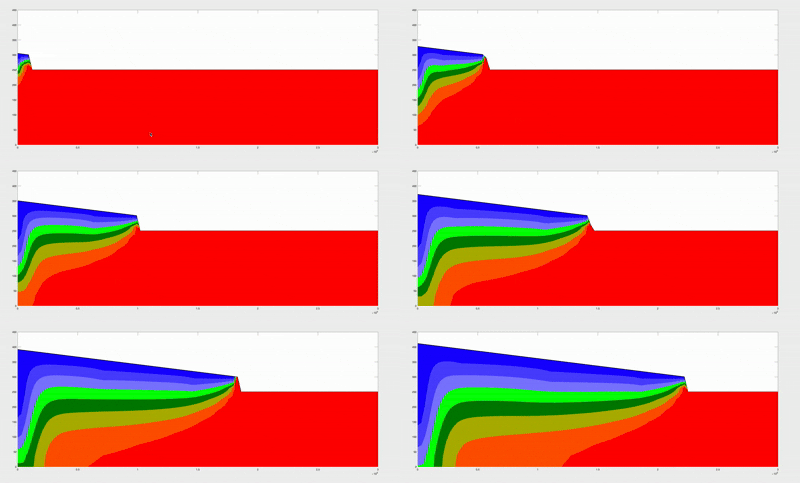
You can see this GitHub repo for some results as well as detailed implementation.
References
[1] Voller, V.R., Sazeed, N., Luong, L., Camille, A., Steckler, M., Leary, K. and Person, M., 2025. Onshore entrapment of seawater in coastal aquifers by rapid coastline progradation. Water Resources Research, 61(8), p.e2024WR038157.